

What is a Linear Motion Guideway and Its Core Mechanisms
1 What is a Linear Guideway
1.1 Linear Motion Guideways
Linear motion guideways (often shortened to "linear guideways") are core mechanical parts used in industrial and consumer equipment to move loads smoothly and precisely in a straight line. The main difference between them and rotary bearings comes down to how they work: rotary bearings let parts rotate (like supporting a shaft’s spin) using rolling elements, but linear guideways tweak this rotary bearing design to turn that rotation into linear motion—so heavy loads can move along a fixed path with very little friction.
1.2 Core Components of Linear Guideways
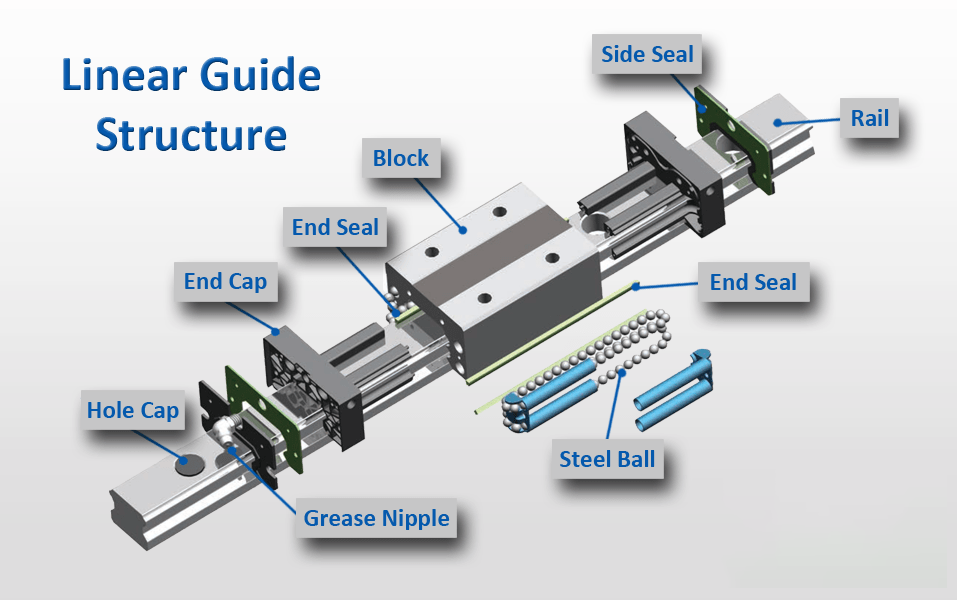
Linear guideways can move stably in a straight line because of three linked core parts; these work together to keep movement smooth and steady:
1.2.1 Carriage
In real-world use, people often call the carriage a "slider." It’s the moving part of the linear guideway assembly. Its main job is to connect to the load (such as a machine tool worktable or robotic arm), slide along the rail, and directly drive the connected equipment to move in a straight line.
1.2.2 Rail
The rail is the fixed support part of the assembly. It’s mounted on a stable base (like a machine tool bed) and provides a rigid, precision-machined path for movement. How straight the rail is and how strong its structure is directly affects how accurately the linear guideway assembly moves.
1.2.3 Rolling Elements
Rolling elements are usually high-precision steel balls (rollers are used for heavy-load situations) and sit between the carriage and the rail. Their key feature is a circulation setup: when the carriage moves, the steel balls roll along the rail’s raceway, then flow back to the start of the raceway through channels inside the carriage, creating a continuous cycle. This setup gets rid of stroke limits (letting "unlimited" linear motion happen) and cuts down friction a lot compared to sliding contact methods.
2 Mechanism and Core Characteristics of Linear Guideways
To fully grasp the value of linear guideways, you first need to understand their role in linear motion systems, then look at the key performance traits that set them apart from traditional parts.
2.1 Overview of Linear Motion Systems
A linear motion system is an integrated part that turns energy into precise linear (or nearly linear) motion. It’s a foundational system for industrial automation, machinery, and consumer equipment. All working linear motion systems rely on two core modules, and linear guideways are a key part of the first module:
2.1.1 Guiding Elements: Defining the Motion Path
Guiding elements keep movement limited to a specific path (like a straight line or arc) and maintain stability while moving. They prevent unintended deviations (such as lateral or rotational backlash) that reduce accuracy. Linear guideway kits are the most widely used guiding elements; others include:
Ball splines: These combine linear and rotational motion (for example, robotic arms that need to slide and rotate at the same time).
Linear bushings: These are simple, cost-effective guiding parts for light-load, medium-precision situations (like light conveyors).
2.1.2 Driving Elements: Providing Motion Power
Driving elements supply the force needed to move loads along the guided path. They turn electrical, hydraulic, or pneumatic energy into linear motion, and their performance directly affects system speed, force, and responsiveness. Common driving elements include:
Ball screws: These use a threaded shaft and ball nut assembly to turn motor rotation into linear thrust. They work well for high-precision, heavy-load situations (like CNC machine tool feed systems).
Linear motors: These are like "unrolled" rotary motors. The stator is fixed next to the rail, and the mover (connected to the carriage) produces linear motion directly—no mechanical transmission (no shaft or nut needed). They let parts move ultra-fast and accelerate quickly (like in semiconductor wafer handling).
Hydraulic/pneumatic actuators: Hydraulic actuators use high-pressure oil (10–30MPa) to generate kilonewton-level thrust (like in steel mill rolling machines). Pneumatic actuators use compressed air (0.5–1MPa) for low-cost, fast motion (like opening industrial doors). Both need linear guide rails to keep motion straight.
2.1.3 Application Flexibility: Beyond Basic Linear Motion
Systems with linear guides can handle complex motion needs. By optimizing linear guideway design (like curved guideways) or combining them with other parts, they can:
Achieve arc motion: Curved guideways guide movement along a circular path (such as rotating worktables in automated assembly lines).
Achieve linear-curved composite motion: Integrate linear and curved guideways to create complex paths—like "picking up parts in a straight line and placing them in an arc" (used in robotic arms that handle parts).
2.2 Core Performance Characteristics
2.2.1 Backlash-Free, Smooth, and Light Motion
This advantage comes from the steel ball rolling contact design—unlike the surface contact of sliding guideways:
Very low friction: The coefficient of rolling friction is only 0.001–0.003, way lower than the 0.1–0.3 coefficient of metal-to-metal surface contact in sliding guideways. This cuts down the force needed to drive the system and saves energy.
No motion backlash: Through precision tolerance design, linear guide kits can be preloaded (controlled slight compression of steel balls) during assembly to eliminate backlash. This makes sure the carriage responds right away when driving force is applied—critical for situations like semiconductor lithography, where "even a micron of backlash causes errors."
2.2.2 Unlimited Linear Motion
Unlike parts like fixed-stroke cylinders, the "unlimited" linear motion of high-precision linear guideways only depends on how long the rail is. This is because of the infinite circulation setup of steel balls: when the carriage moves, steel balls roll forward along the rail’s raceway, pushing the balls ahead into the carriage’s internal return channel. The channel then guides them back to the start of the raceway, creating a continuous cycle. This setup means steel balls never hit an "end," so the carriage can slide along the rail infinitely. It’s good for long-stroke conveyors (like in car factories) or large machine tool worktables that need to cover several meters.
2.2.3 High Allowable Load
The "surface contact" design of steel balls and curved raceways (better than the point contact of linear bushings) gives linear guideways a much higher load capacity:
Advantage of contact area: Steel balls in linear bushings only make "point contact" with the shaft, which limits load because stress is concentrated. The curved raceways of linear guideways match the curvature of steel balls, creating a larger contact area that spreads load evenly.
Load capacity comparison: For the same size, linear guideway rails can handle about 13 times more load than point-contact linear bushings. For example, a standard miniature linear guideway can take a radial load of 5kN, while a linear bushing of the same size can only handle 380N.
This trait makes them good for heavy-load situations—like industrial robots lifting metal parts or machine tools cutting thick workpieces—without needing overly large parts.