

Application, Classification, Accessories, and Customization of Linear Guideways
1 Application Fields of Linear Guideway Kits
1.1 Core Industrial Applications
1.1.1 Machine Tool Equipment
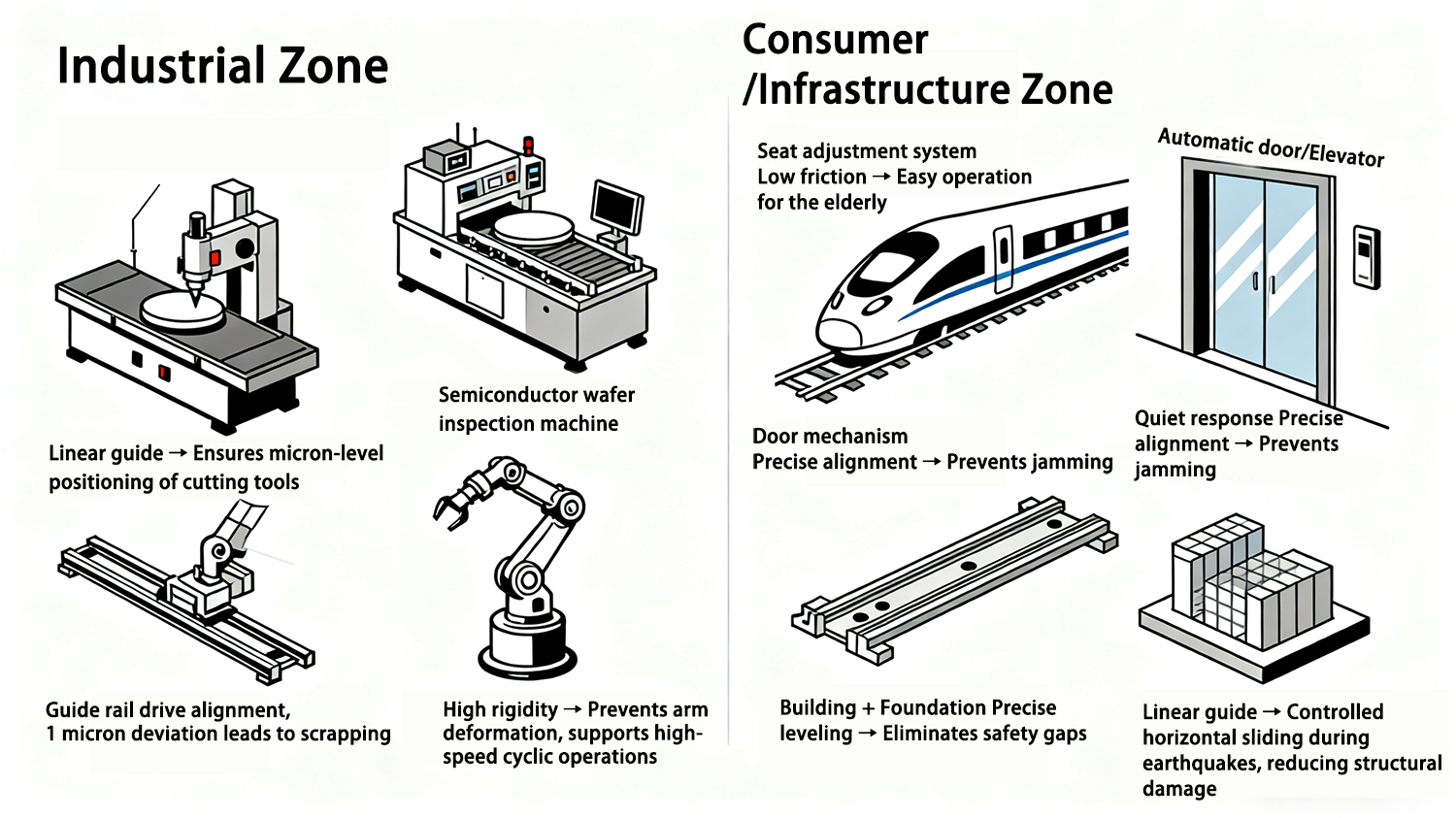
Linear guideways are key guiding parts in CNC (Computer Numerical Control) machine tools (like CNC milling machines, lathes, and grinders), and how well they work directly impacts how accurately workpieces are machined. During processes like cutting, drilling, and grinding, tools or workpieces need to move along a fixed path with barely any deviation. Linear rails make sure this precision happens in two main ways:
Reducing mechanical vibration: The rolling contact design minimizes vibration caused by friction, which avoids "chatter" (unstable cutting) that ruins surface quality.
Ensuring consistent positioning: Strict control over clearances and high rigidity eliminates "backlash" (unintended movement), so tools can move with micron-level precision along programmed paths.
1.1.2 Precision Instruments
In precision measurement, inspection, and manufacturing gear (such as semiconductor wafer inspection machines, optical profilers, and medical imaging devices), linear guideways let parts move tiny distances and stay controlled—this is key to getting accurate results. For example:
In semiconductor manufacturing, high-precision linear guideways move wafer stages to line up with lithography equipment; a 1-micrometer misalignment can make an entire batch of chips useless.
In medical diagnostic gear (like MRI scanners and CT scanners), linear guideway assemblies control how detectors or patient beds move. This precise alignment cuts down scan times and makes images clearer.
Their low-friction, high-repeatability traits make them perfect for situations where "micro-motion accuracy directly affects how reliable data is."
1.1.3 Industrial Robots
Industrial robots (such as assembly robots, pick-and-place robots, and welding robots) depend on linear guideway sets to boost joint precision, structural rigidity, and high-speed performance. Robotic arms often need to move both linearly and rotationally at the same time, and linear guideways support this in three ways:
Precise joint movement: At robotic arm joints, the smooth linear motion of linear guides works with rotating parts (like servo motors) to get end effectors (grippers, welding torches) to exact target positions.
Stronger structural rigidity: High rigidity stops the arm from bending under load (like when lifting heavy objects), so positioning stays accurate even during dynamic operation.
Handling high-speed cycles: In automated assembly lines, robots need to finish hundreds of cycles per minute. The low friction of high-rigidity linear guideways cuts energy use and wear, keeping them running steadily long-term.
1.2 Consumer and Infrastructure Applications
1.2.1 Transportation
In rail vehicles (high-speed trains, commuter trains) and buses, precision linear guideways support functions that affect comfort and safety:
For seat adjustment systems: They let passenger seats slide forward/backward and adjust backrests smoothly and quietly. Low friction means even the elderly or people with disabilities can operate them easily.
For door operating mechanisms: They make sure train and bus doors line up correctly and open/close reliably, preventing jams that could risk passenger safety or delay operations.
For braking and suspension parts: In some high-speed trains, they guide how brake pads or suspension parts move, reducing friction and wear to keep braking responsive and driving stable.
1.2.2 Daily Facilities
Automatic doors (in malls, airports, office buildings): They control sliding door movement, making sure doors respond quickly to sensors (motion detection, access cards) and operate quietly. This cuts down noise in crowded spaces and makes doors easier for everyone to use.
Elevator guiding systems: When elevator cars move up and down shafts, the high rigidity and low friction of linear guideway rails keep rides smooth (so passengers don’t feel uncomfortable) and ensure precise leveling. This eliminates gaps between the car and floor, preventing safety risks for kids or wheelchair users.
1.2.3 Building Seismic Isolation Systems
In earthquake-prone areas (like Japan or California, USA), linear guideways are core parts of building seismic isolation systems—they can greatly reduce earthquake damage to structures. Traditional buildings are rigidly connected to their foundations, so seismic waves travel straight through, causing cracks or collapse. Isolation systems use linear guideways to:
Enable controlled horizontal movement: Linear guideway rails are installed at the base of buildings. During an earthquake, the building can slide horizontally relative to the foundation, "decoupling" the building from seismic waves and reducing the force transferred to the structure.
Ensure post-earthquake stability: High rigidity stops excessive movement (like tilting), so the building returns to its original position after the earthquake.
2 Technology and Product Classification of Linear Guideways
Linear guideways work in so many areas because of their innovative core design and wide range of products—you can pick the right one for different situations based on what you need.
2.1 Core Working Principle
Linear guideways work by tweaking existing bearing technology, plus design improvements that let them outperform traditional linear parts:
2.1.1 Technical Foundation: Modifying Deep Groove Ball Bearing Principles
The core setup of linear guideways comes from deep groove ball bearings (the most common rotary bearings). In deep groove ball bearings, steel balls roll between inner and outer raceways to reduce rotational friction. Linear guideways adjust this "rolling friction" principle for linear motion:
The inner ring of rotary bearings becomes the carriage of linear guideways (the moving part).
The outer ring of rotary bearings becomes the rail of linear guideways (the fixed path part).
The steel balls and circulation setup stay, but the direction of motion changes from "circling the bearing ring" to "moving straight along the rail raceway."
This tweak keeps the low-friction advantage of deep groove ball bearings while changing their function from rotation to linear motion.
2.1.2 Performance Breakthrough: "Ball + Curved Raceway" Surface Contact Design
The key innovation that makes linear guideways better than traditional linear parts is the "curved raceway" (replacing flat surfaces). This creates "surface contact" and brings two big advantages:
13x higher load capacity: Compared to traditional point-contact linear bushings, surface contact spreads stress evenly. For the same size, linear guideways can handle about 13 times more load. For example, a 15mm-diameter linear bushing can take a radial load of 400N, while a linear guideway of the same size can reach 5.2kN. This makes them good for heavy-load uses like machine tool worktables and robotic arm lifting.
Ultra-long service life (up to 2200x in some cases): Surface contact reduces wear between steel balls and raceways. The circulation setup also spreads the load evenly across all steel balls, cutting wear even more. Under standard conditions (50% of rated load, clean environment, good lubrication), linear guideways can last up to 2200 times longer than traditional linear bushings. This slashes maintenance costs and downtime for equipment.
2.2 Product Classification by Application Requirements
To meet different needs—from semiconductor precision manufacturing to heavy machinery—linear guideways are split into three categories based on application needs:
2.2.1 Classification by Load Distribution
These are optimized to handle forces from different directions, preventing early failure and keeping accuracy:
Radial Load Type: Raceways are designed first to handle "radial forces" (forces perpendicular to the rail length, like the weight of a machine tool worktable). Good for situations where loads act vertically on the motion path (such as vertical sliding doors of industrial furnaces or simple conveyors).
Four-Way Equal Load Type: Raceways are arranged symmetrically to handle radial, lateral, and moment loads evenly. For example, when a robotic arm pushes, pulls, and lifts parts at the same time (multi-directional forces). Good for high-precision dynamic situations (like semiconductor wafer handling or automated assembly robots).
2.2.2 Classification by Structural Size
These balance load capacity, precision, and space efficiency:
Wide Linear Guideways: The rail and carriage are wider, which increases the contact area with the mounting base. This boosts stability and load capacity, and reduces bending under heavy loads. Good for heavy-duty machine tools (large CNC milling machines) and industrial cranes.
Miniature Linear Guideways: These are ultra-compact (rail width as small as 3mm) and lightweight. They prioritize space efficiency without losing precision. Good for small equipment (portable ultrasound machines, high-end 3D printer nozzles).
2.2.3 Classification by Special Functions
These integrate extra features to solve complex motion challenges:
Cross Guideways (e.g., CSR Type): Combine two perpendicular linear guideways to enable "orthogonal motion" (X/Y axes) in a small space. This eliminates alignment errors that come with separate guideways. Good for optical inspection systems (camera scanning horizontally/vertically) and miniature robotic worktables.
Linear-Curved Composite Guideways (e.g., HMG Type): Connect linear and curved sections (like 90° arcs) seamlessly. This lets parts move in "integrated linear-arc motion" without switching guideways, simplifying the system. Good for automated packaging lines (conveying in a straight line and sorting in an arc) and rotating worktables.
Rack-Integrated Guideways: The rail has a built-in rack, and the carriage has a built-in gear. This combines linear motion with precise positioning. Gear meshing lets the carriage stop accurately along the rail or allows multiple carriages to move in sync. Good for automated warehousing (robots picking items precisely) and multi-station conveyor lines.
3. Accessories and Related Products of Linear Guideways
3.1 Core Auxiliary Accessories
Accessories are designed to fix key problems with linear guideways (like contamination, lubrication, and precision feedback) and keep them running steadily:
3.1.1 Protective Components: Dust Protection Devices
Foreign matter—like metal chips, dust, or liquid droplets—can scratch raceways, jam rolling elements, or speed up wear. Dust protection devices create a physical barrier:
Scraper Seals: Elastic rubber or polyurethane scrapers are installed at both ends of the carriage. As the carriage moves, they scrape debris off the rail surface. Good for moderately dirty environments.
Bellows Covers: These are accordion-style fabric or plastic covers that stretch and contract as the carriage moves. They fully cover the rail and carriage. Good for very dirty situations (like milling machine chips).
Labyrinth End Caps: These are rigid plastic end caps with complex maze-like channels that trap debris outside. Good for low-to-moderate contamination (like paper dust in packaging lines).
These devices can extend the life of linear guideways in harsh environments by 30%–50% and cut down unplanned maintenance.
3.1.2 Lubrication Components: Long-Life Lubrication Units
Lubrication is key to keeping linear guideways low-friction and corrosion-resistant. Traditional manual lubrication (with grease guns) takes time and is easy to mess up—long-life lubrication units fix this:
Built-in Oil Reservoirs: Small replaceable reservoirs (filled with grease or oil) are installed on the carriage. Lubricant is released slowly through capillary action or pressure from the carriage’s movement.
Longer Intervals: Depending on the model and working conditions, lubrication only needs to be done every 6–24 months (compared to every 1–2 months for manual lubrication).
Even Distribution: Makes sure