

How High-Precision Ball Splines Enhance Automation Efficiency?
A ball spline is a high-precision mechanical transmission component designed to fulfill the core functions of torque transmission and the realization of compound motion—seamlessly integrating high-accuracy linear movement with rotational motion. Unlike traditional sliding splines that rely on direct surface contact, the ball spline utilizes recirculating steel balls to convert sliding friction into rolling friction, a design that underpins its standout advantages: significantly lower frictional resistance, enhanced rigidity and load-bearing capacity, minimal wear over prolonged use, and consistent motion precision even under high-speed or heavy-load conditions.
I. Structure of Hojama Ball Splines
Hojama Ball splines are primarily classified by their structural forms, with the two most prevalent categories being external circulation ball splines and internal circulation ball splines. External circulation models feature a design where steel balls exit the raceway between the spline shaft and sleeve, circulate through external channels, and re-enter the raceway—creating an open-loop circulation path. In contrast, internal circulation ball splines integrate circulation channels within the sleeve itself; balls move through internal holes or grooves inside the sleeve without exiting the assembly, forming a closed-loop circulation system.
The key structural components of a ball spline include four essential parts: the spline shaft, the sleeve, the steel balls, and the cage. The spline shaft, with precision-machined grooves along its length, serves as the foundation for torque transmission and linear motion guidance. The sleeve, which encloses the shaft, houses the circulation channels and provides a stable housing for the other components. Steel balls, made of high-hardness alloy steel, act as the core rolling elements that reduce friction and enable smooth motion transfer. The cage, often made of engineering plastics or metal, maintains uniform spacing between the balls to prevent collision, ensure consistent load distribution, and stabilize the circulation path.
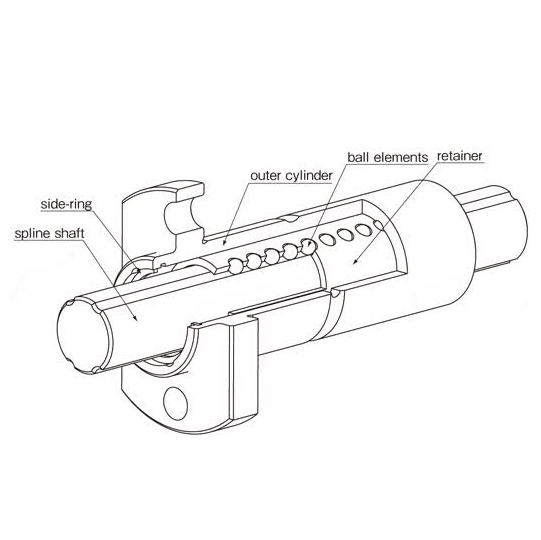
External circulation ball splines excel in load-bearing capacity due to their larger ball size and more robust circulation structure, making them ideal for heavy-load scenarios such as large CNC machine tools or industrial lifting equipment. They also offer relatively easy maintenance, as external channels are accessible for inspection or lubrication. However, their external circulation design results in a slightly larger overall size, which may limit installation in space-constrained environments. Internal circulation ball splines, by contrast, boast a more compact structure and higher precision grades due to the closed-loop circulation that minimizes ball runout. Their smaller footprint enhances installation adaptability for compact devices like robotic joints or precision linear actuators, though their smaller ball size and internal channels lead to lower maximum load capacity compared to external circulation models. Additionally, internal circulation types typically require more specialized maintenance due to the inaccessibility of internal channels.
II. Material Selection of Hojama Ball Spline Kits
The material selection for ball splines directly impacts their mechanical performance, durability, and adaptability to working conditions, starting with the main structural materials—primarily the spline shaft. Commonly used metals for spline shafts include stainless steel and alloy steel. Stainless steel is favored for applications involving moisture, chemicals, or food processing due to its excellent corrosion resistance and moderate strength, while alloy steel, after heat treatment, offers superior hardness, tensile strength, and torque-bearing capacity—making it ideal for heavy-duty scenarios like industrial machinery and automotive transmissions where high load resistance is critical.
For steel balls and supporting components, materials must prioritize wear resistance, impact resistance, and dimensional stability. Steel balls are typically manufactured from high-carbon chromium-bearing steel, which undergoes precision grinding and heat treatment to achieve a high hardness and smooth surface, minimizing friction and wear during long-term operation. Sleeves, which work in close coordination with steel balls, often use the same alloy steel as spline shafts or high-strength cast iron to ensure sufficient rigidity and load-bearing capacity. Cages, meanwhile, are commonly made of engineering plastics or lightweight metals; plastics offer low friction, corrosion resistance, and noise reduction, while metals are preferred for high-temperature or high-load environments where plastic deformation may occur.
The material selection principles for ball spline sets are guided by three core factors: torque requirements, working environment, and service life. For high-torque applications, high-strength alloy steels are selected to prevent shaft deformation or fracture. In harsh environments—such as humid workshops or high-temperature foundries—stainless steel or heat-resistant alloys are prioritized.
III. Manufacturing of High-Precision Ball Spline Assemblies
The manufacturing of ball splines relies on a combination of foundational forming processes and precision finishing techniques to ensure structural integrity and motion accuracy, starting with the core manufacturing processes for key components like the spline shaft. For the initial shaping of the spline shaft, hot rolling and cold rolling are the two primary foundational methods. Hot rolling involves heating metal billets to high temperatures and passing them through rolling dies to form the basic spline profile; this process is efficient for mass production, reduces material waste, and improves the metal’s internal grain structure to enhance overall strength. Cold rolling, by contrast, is performed at room temperature, using pressure to shape the spline profile without heating; it produces a smoother surface finish and tighter dimensional tolerance than hot rolling, making it suitable for components requiring preliminary precision before finishing.
Complementing these foundational processes is the precision finishing of ball raceways—a critical step to ensure smooth ball circulation and accurate motion. This typically involves grinding to achieve the precise arc shape and surface roughness of the raceways, followed by lapping for ultra-high precision applications, which further refines the surface to minimize friction and improve wear resistance. For sleeves, similar finishing processes are applied to internal raceways to ensure seamless coordination with the spline shaft and steel balls.
To maintain strict precision standards, a series of precision assurance measures is implemented throughout production. Surface treatment techniques, such as carburizing or nitriding, are used to increase the surface hardness of spline shafts and sleeves, enhancing wear resistance without compromising core toughness. Dimensional calibration is conducted using high-precision measuring tools to verify key dimensions—including spline pitch, raceway radius, and shaft straightness—ensuring compliance with international standards.
Different manufacturing processes exert distinct impacts on product performance. Hot-rolled components exhibit higher strength and ductility due to the optimized grain structure from high-temperature processing, making them suitable for heavy-load applications. Cold-rolled parts, with their superior, smoother surface and dimensional stability, reduce initial friction and require less post-processing, improving assembly efficiency. Precision grinding and lapping significantly enhance motion accuracy by minimizing raceway irregularities, ensuring consistent ball rolling, and reducing vibration during linear or rotational motion—critical for high-speed CNC machines or robotic arms.
IV. Wide Application of Ball Spline Kits
In the heavy machinery sector, linear ball splines are widely employed in core equipment where durability, high load-bearing capacity, and motion accuracy are critical. In automated manufacturing equipment, they enable precise linear positioning of robotic arms while ensuring stable torque transfer during workpiece handling—supporting 24/7 continuous operation with minimal maintenance. Robotic joints rely on ball splines to achieve flexible, high-speed rotational and linear movements, as their low friction and high rigidity prevent motion lag and ensure repeatable positioning accuracy. Additionally, in CNC machine tools, ball splines are integrated into feed axes to transmit torque for spindle rotation while guiding linear tool movement, directly enhancing machining precision and surface quality of workpieces.
The consumer goods and transportation sector leverages ball splines for applications requiring compact design, quiet operation, and reliable performance. In precision transmission equipment for consumer electronics, their small footprint and smooth motion meet the demand for miniaturization and low noise. In NEV industry, ball splines are used in key components such as EV drive shafts, battery swapping mechanisms, and steering systems—their corrosion resistance and high torque capacity adapting to the harsh under-vehicle environment while improving energy efficiency by reducing frictional energy loss. They also find use in automotive seat adjusters, enabling precise linear and rotational adjustments for passenger comfort.
For specialized industries with extreme operating conditions or ultra-high precision requirements, ball spline kits are customized to meet rigorous standards. In the aerospace industry, they are applied in aircraft control systems and satellite deployment components—manufactured from lightweight, high-strength alloys and subjected to strict vacuum and temperature resistance tests to ensure reliability in space or high-altitude environments. In medical equipment, ball splines with ultra-smooth surfaces and sterile materials prevent contamination while enabling micro-motion control for delicate surgical procedures or accurate image positioning. In scientific research instruments, their nanoscale motion precision and low vibration characteristics support experiments requiring extreme accuracy, such as quantum computing component assembly or astronomical observation adjustments.
V. Selection Key Points and Precautions of Hojama Ball Splines
Four core parameters directly determine the suitability of a ball spline for specific applications: torque-bearing capacity, stroke range, precision grade, and operating temperature. Torque-bearing capacity refers to the maximum torque the spline can transmit without deformation or failure; it must be matched to the system’s peak torque requirements. Stroke range, the maximum linear distance the spline can move, should align with the system’s motion range—oversized strokes increase cost and installation space, while undersized strokes limit functionality. Precision grade, typically defined by international standards, dictates positioning accuracy and motion smoothness; high-precision applications like surgical robots demand P2 or P3 grades, while general industrial equipment may use P5 or P7 grades. Operating temperature range is another critical factor: standard ball splines work reliably between -20°C and 80°C, but high-temperature environments require heat-resistant materials and high-temperature lubricants to avoid lubricant degradation or material softening.
Linear motion ball spline sets must be compatible with supporting components to ensure seamless integration, with two primary adaptation requirements: shaft diameter matching and installation space constraints. Shaft diameter matching involves aligning the spline shaft’s outer diameter with the inner diameter of the sleeve and associated components; mismatched diameters can cause excessive friction, uneven load distribution, or even mechanical jamming. For example, a spline shaft with a 30 mm diameter requires a sleeve with a corresponding inner diameter. Installation space constraints refer to the physical dimensions of the spline relative to the system’s available space; compact applications like robotic joints may require miniaturized ball splines, while large industrial machinery can accommodate larger models. Additionally, mounting orientation should be considered—vertical installations may require additional anti-drop mechanisms to prevent sleeve slippage under gravity.