

How to prevent dust on linear guides and resolve slider clogging?
I. Introduction
Linear guide rails stand as indispensable components in modern industrial systems, facilitating precise linear motion with minimal friction across a diverse array of high-demand sectors. However, the performance and longevity of linear guide rails are significantly jeopardized by harsh environmental factors, with dust, moisture, and corrosion emerging as primary culprits.
II. Dustproof Treatment Technology for Linear Guideway Kits
Dustproofing constitutes a foundational aspect of linear guide rail maintenance and performance preservation, as the intrusion of foreign particles—ranging from fine industrial dust and metal shavings to abrasive contaminants—poses a direct threat to the guide rail’s operational integrity.
1) Sealing Structure Design
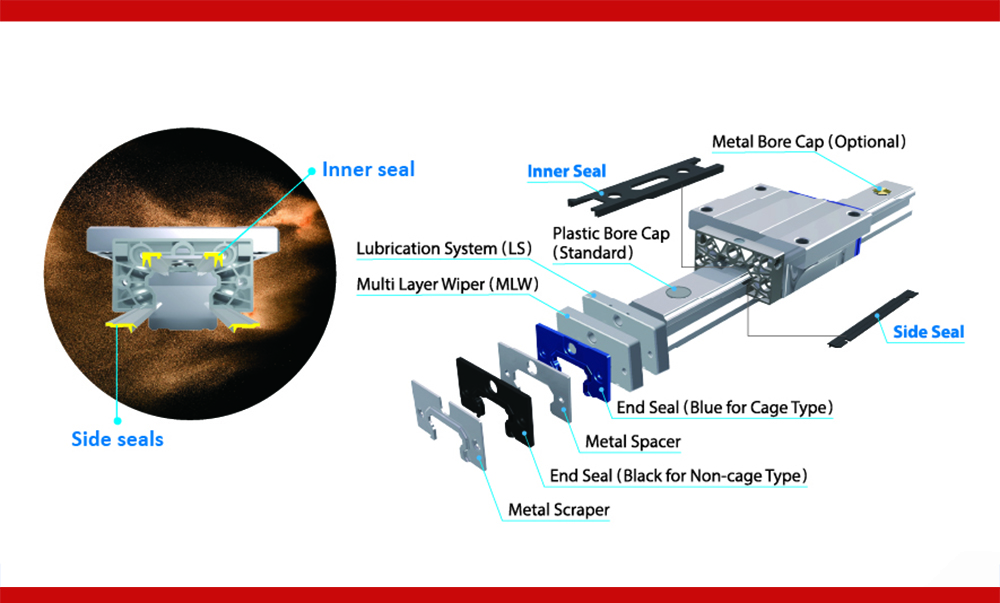
Rubber seals—typically made from nitrile rubber (NBR), fluororubber (FKM), or silicone—are widely used for their flexibility and excellent sealing performance at moderate temperatures; they are often integrated into the carriage end caps to form a tight barrier between the external environment and the guide rail’s internal components.
2) Surface Treatment
Surface treatment technologies focus on reducing dust adhesion and minimizing the impact of any particles that bypass initial seals. Precision grinding and polishing of the guide rail’s raceway and carriage surfaces result in an ultra-smooth finish with low surface roughness (Ra ≤ 0.1 μm), thereby reducing the physical adhesion points for dust particles. This smooth surface also facilitates the formation of a uniform lubrication film, which further repels contaminants.
3) Coating Treatment
Specialized dustproof coatings provide an additional protective layer that repels dust and reduces friction. These coatings are typically applied via spray, dip, or electrostatic methods, ensuring uniform coverage across the guide rail’s critical surfaces.
III. Waterproof Treatment Technology for Linear Guide Assemblies
Moisture poses a significant threat to the functionality and longevity of linear guide rails, with far-reaching consequences for both operational performance and service life.
1) Sealing Structure Design
Similar to dustproofing, robust sealing structures form the primary defense against moisture intrusion, with designs adapted to prevent water penetration while accommodating dynamic motion. The common sealing types employed in dustproofing—including rubber seals, metal seals, and cover seals—are equally integral to waterproofing, albeit with modifications to enhance water resistance. These seals are frequently combined with drainage channels to redirect any infiltrated water away from sensitive components.
2)Waterproof Coating Treatment
Specialized waterproof coatings create an impermeable layer on guide rail surfaces, blocking moisture absorption and enhancing corrosion resistance. Polyurethane coatings are widely used for their exceptional water resistance, flexibility, and adhesion to metal substrates. Polyurethane-fatty acid ester coatings offer improved chemical resistance alongside waterproofing, ideal for environments where guide rails are exposed to water-based coolants or mild solvents. Epoxy resin coatings provide a hard, rigid barrier with high resistance to water and mechanical stress, often used in heavy-duty applications where durability is paramount.
3)Material Selection
Choosing inherently water-resistant materials for guide rail components is a foundational waterproofing strategy, reducing reliance on external treatments. Stainless steel—particularly grades like 304 or 316, which contain chromium and nickel—forms a passive oxide layer that resists corrosion and repels moisture, making it a staple in wet environments such as food processing, marine, or outdoor machinery.
IV. Anti-corrosion Treatment Technology for Linear Guide Rails
Corrosion poses a severe threat to linear guide rails, as it gradually erodes their structural integrity and undermines critical performance metrics. This not only weakens the rail’s load-bearing capacity and dimensional stability but also disrupts the precision of linear motion, causing increased friction, vibration, and uneven wear.
1) Anti-corrosion Coating Treatment
Specialized anti-corrosion coatings act as a protective barrier, isolating the guide rail’s metal surfaces from corrosive environments and inhibiting chemical reactions.
2)Material Selection
Choosing inherently corrosion-resistant materials for guide rail construction is a proactive strategy to minimize vulnerability to corrosion, such as stainless steel, aluminum alloys, and more. For non-load-bearing components, engineering plastics (e.g., polypropylene, PEEK) provide inherent corrosion resistance and are often used in conjunction with metal rails to minimize contact between corrosive agents and critical metal parts.
3)Surface Treatment
Surface treatment technologies enhance corrosion resistance by refining the guide rail’s surface properties, reducing vulnerability to corrosive attack. Precision grinding and polishing create a smooth, uniform surface with minimal micro-irregularities, eliminating crevices where moisture, dirt, or corrosive agents can accumulate and initiate corrosion. A low surface roughness also promotes better adhesion of anti-corrosion coatings, ensuring their effectiveness. Electrochemical polishing further enhances surface smoothness by removing microscopic burrs and oxides through electrolysis, leaving a bright, passive layer that resists chemical penetration.
V. Daily Maintenance of Linear Guide Rails
1. Regular Cleaning: Periodic removal of dust, debris, and residual lubricants prevents abrasive wear and contamination. For most guide rails, this involves wiping the rail surface and carriage with a clean, lint-free cloth or soft brush. In high-contamination environments, compressed air or low-pressure water may be used to dislodge stubborn particles, followed by wiping to avoid re-deposition. Specialized cleaning agents can be applied sparingly to remove oil-based residues without damaging seals or surfaces.
2. Lubrication: Proper lubrication reduces friction between moving parts, forms a protective barrier against moisture and dust, and minimizes wear. The type of lubricant (grease or oil) and frequency of application depend on the guide rail’s design, load, speed, and environment.
3. Inspection: Visual and functional checks identify early signs of damage or degradation. Inspect for rust, pitting, or scratches on raceways and rolling elements; wear or cracking in seals; loose fasteners; and irregular noise or vibration during operation.
4. Calibration: Over time, guide rails may experience minor misalignment due to thermal expansion, vibration, or mounting surface shifts. Regular calibration—adjusting the rail’s parallelism, levelness, or preload—restores positional accuracy.
Key Precautions
1. Avoid Overload: Exceeding the guide rail’s rated load capacity accelerates fatigue, deforms raceways, and damages rolling elements, leading to reduced precision and premature failure.
2. Minimize Vibration: Excessive vibration—from nearby machinery, uneven mounting, or unstable operation—causes loosening of fasteners, increased friction, and abrasive wear between components.
3. Handle with Care: During maintenance or component replacement, avoid striking guide rails with hard tools, as impacts can dent raceways or distort structural parts. Clean hands or gloves should be worn to prevent the transfer of oils, acids, or contaminants from skin to sensitive surfaces.